

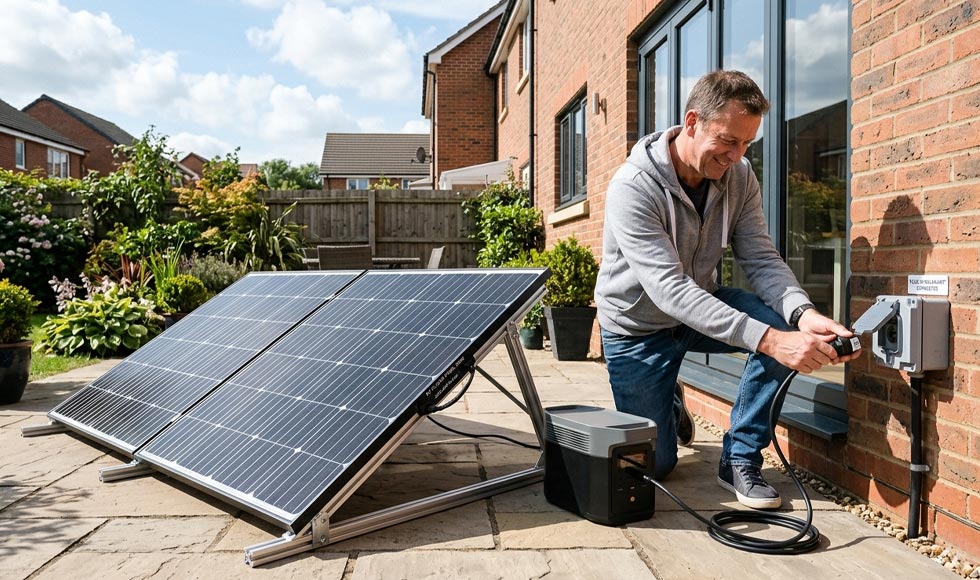
The government is bringing cheap, DIY solar power to the high street to cut energy bills, but do they really measure up to traditional rooftop solar?
A wave of new plug-in solar panels is set to hit UK shops, with retailers like Lidl preparing to sell low-cost kits designed to bring renewable energy to the masses. Backed by government efforts to cut energy bills and reduce reliance on fossil fuels, these DIY-friendly systems promise a simpler way for households to generate electricity at home.
But while the concept sounds appealing, a closer look suggests plug-in solar panels may fall short when compared with traditional rooftop solar installations.
A cheaper, simpler but smaller solution
Plug-in solar panels are essentially compact solar kits that can be connected directly to a standard wall socket. Unlike conventional systems, they don’t require professional installation or integration into a home’s wiring.
This simplicity is reflected in the price. Early reports suggest they could cost around £400, making them far more accessible than rooftop systems, which typically start at £4,000–£6,000.
However, that affordability comes with a significant trade-off – scale.
Most plug-in systems only generate a small amount of power and are designed to offset small, constant energy demands, such as running a fridge or Wi-Fi router.
By contrast, a professionally installed rooftop system can generate several thousand kilowatt hours annually, enough to power a substantial portion of a home.
Limited savings and slower impact
The reduced output of plug-in panels directly affects their financial benefits. Estimates suggest a typical plug-in system could save households roughly £90 per year.
While any saving is welcome, it pales in comparison to traditional solar systems, which can deliver far greater reductions in energy bills, in some cases reaching into the thousands annually when paired with solar battery storage.
In other words, plug-in panels may slightly chip away at electricity costs, but they are unlikely to make a meaningful dent for most households.
Convenience over performance
There’s no denying the appeal of plug-in solar, no scaffolding, no electricians, and no complex paperwork. For renters or flat dwellers without roof access, they may offer a rare entry point into renewable energy.
Yet this convenience is also their biggest limitation. Because they are not fully integrated into a home’s electrical system, they lack the efficiency, scalability, and optimisation of traditional solar installations.
They also cannot store energy unless paired with additional equipment, meaning any unused electricity is effectively lost rather than saved for later use.
Regulatory and safety questions remain
Plug-in solar panels are not yet widely available in the UK, partly due to concerns about wiring safety and regulatory compliance. Changes are expected soon, but questions remain about how well existing homes can accommodate these systems.
Traditional solar installations, on the other hand, are already well-regulated, professionally installed, and optimised for long-term reliability and significant savings on electricity bills.
Interested in saving real money on your energy bills?
If you want to really reduce your electricity bills, make better use of solar energy, and future-proof your home energy system, traditions solar PV systems are the ideal solution. Contact us today to discover how we can transform the way your home uses energy.