

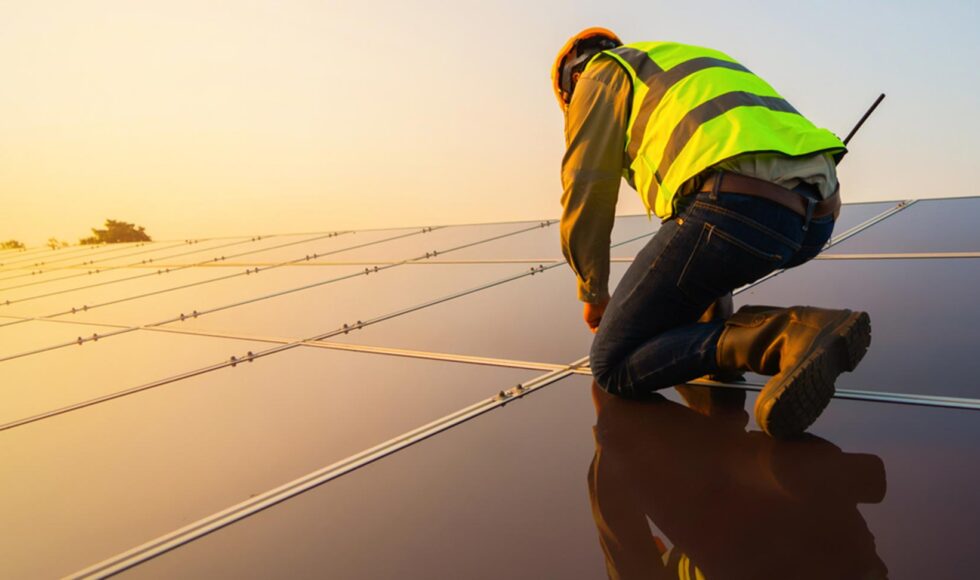
How many solar panels your home needs will depend on how much electricity you use and the space on your roof.
If you’re looking at getting solar panels for your home, you’re probably also wondering ‘how many solar panels do I need?‘. Researching solar PV panels can be overwhelming, and we’re here to help guide you on how you and your home can benefit. A typical three-bedroom house uses 2,900kWh and will require 10 panels – a 3.5kW system (on average). Getting the correct-sized solar PV system for your home will require the help of an expert, and we’ve got our own solar team on hand to help with any solar enquiries.
How many solar panels your home needs will vary on a few important factors, and we’ll cover this in more detail below.
Can I run my house on solar power?
Solar panels can cover around 50% of your annual usage, more so if you’re out of the home for longer periods. If you’re not using all the electricity you produce, you have one of two options: sell back to the grid or add a solar battery. Under the Smart Export Guarantee, you can sell surplus electricity back to the National Grid. With a solar battery, you can store this electricity for later use.
The size of your home and the number of appliances you use will determine how much solar power you need to generate. Other factors including roof space and the direction your roof faces will need to be considered.
How many solar PV panels will power my house?
The exact answer on the number of panels needed for any home will vary for every household. It’s important to consider the amount of electricity you use in the home, including:
- The size of your house
- The number of people living there
- The insulation you have
- The use of gas and electric
Based on averages, you will find that:
- A one-bedroom house needs six solar panels (2.1kW)
- A three-bedroom house requires 10 solar panels (3.5kW)
- A five-bedroom house needs 14 solar panels (4.9kW)
Is my roof suitable for solar panels?
Not every roof space is suitable. The panels are best placed on a south-facing roof where they’ll catch the most rays. North-facing roofs are not suitable due to the lack of sufficient sunlight they receive.
The suitability and condition of your roof also need to be considered to determine if it can support the weight of the panels. The size of your roof will establish how many panels can fit. If you’ve got a smaller roof, you may benefit from fewer panels with a higher power rating.
Do solar panels work on cloudy days?
A frequent question we get asked is ‘do solar panels work on cloudy days?’. The answer is yes. They can produce power even on cloudy days, but they will reach maximum efficiency during peak sunlight hours. The annual sunlight in hours for the UK is 1,402.72.
Here’s a breakdown on the average of sunlight in the UK per month:
| Month | Sunshine* (hours) |
| January | 47.51 |
| February | 71.93 |
| March | 109.24 |
| April | 155.38 |
| May | 192.21 |
| June | 171.48 |
| July | 173.38 |
| August | 161.64 |
| September | 127.49 |
| October | 91.81 |
| November | 57.93 |
| December | 42.71 |
*Different regions in the UK have different sun hours per day.
How many solar panels will I need?
There are several factors that determine how many solar panels are needed for your home. Lifestyle choices, roof space, how much electricity you use in your home will ultimately determine the number of solar panels. Getting a quote from a professional installer is the best way to determine this.
How do I get a quote for a solar PV system?
If you’re ready to start your solar PV journey, contact our team today.
We’re MCS accredited (a quality assurance scheme supported by the UK government) and we’ll always take the time to understand your needs and budget. All quotes come with a custom solar panel system design, the complete costs, installation time, expected performance, and payback period.
Top tip: Dig out electricity bills from the last 12 months. This will give you, and us, a full picture of the average use in your home. With this information, our team can quickly calculate the number of panels needed.